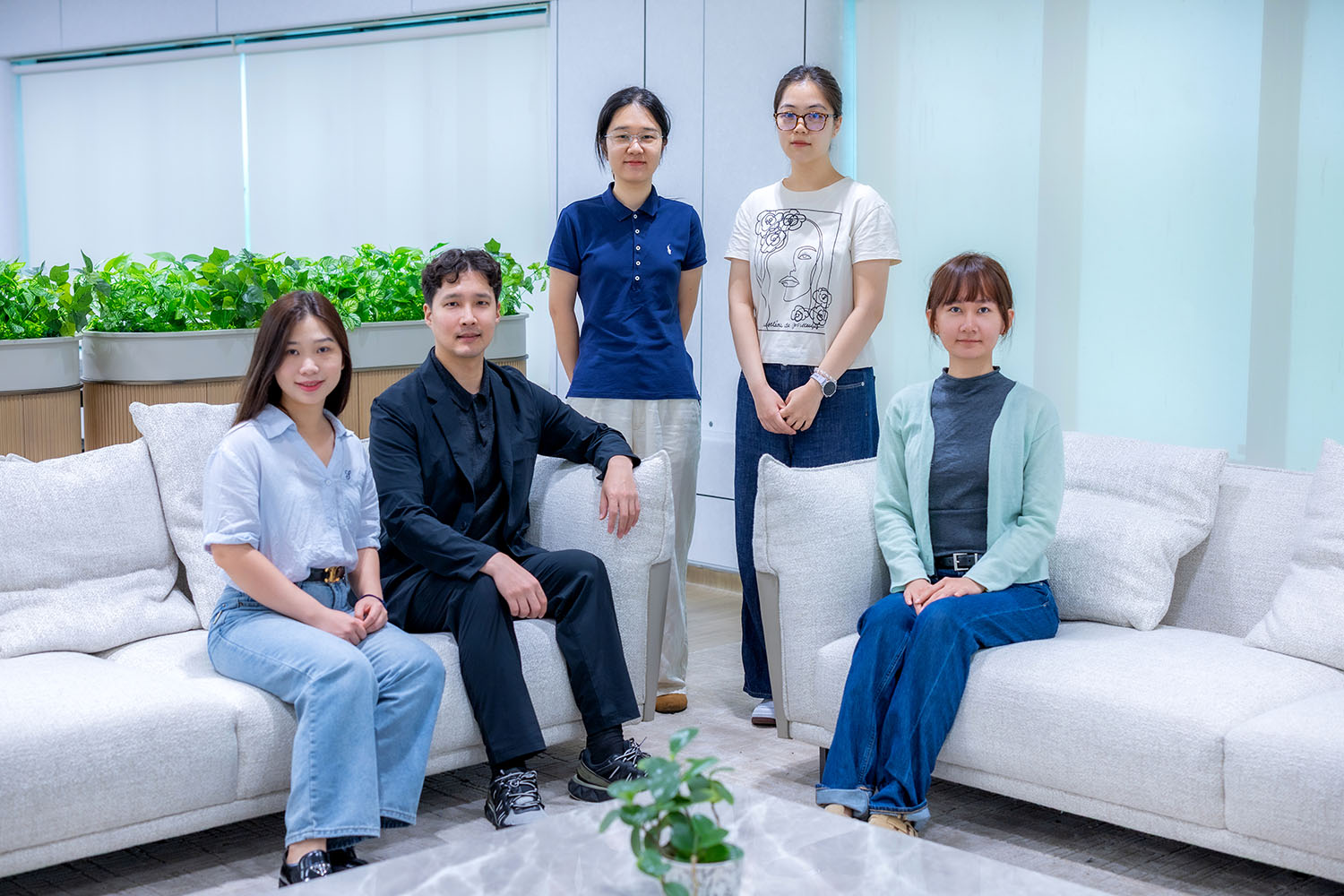
The research team was led by Professor Sang Jin Lee (second from left), Assistant Professor in Biofunctional Materials
Press Release
A research team from the Faculty of Dentistry at The University of Hong Kong (HKU), working in collaboration with Professor Su Ryon Shin’s group at Brigham and Women’s Hospital, Harvard Medical School, has advanced and preclinically validated a shape-adaptive hydrogel designed for challenging clinical trauma scenarios involving severe bleeding, irregular bone defects and comminuted fractures.
The findings, published in Advanced Materials, demonstrate the potential of the novel biomaterial, named iHEÄLS, as a versatile platform for complex craniomaxillofacial reconstruction. Inspired by the familiar malleability of Play-Doh, the hydrogel can be shaped and adapted to irregular anatomical defects while combining rapid haemostasis, strong tissue adhesion, self-healing capability and mechanical resilience—properties that are particularly relevant to emergency trauma care.
The HKU research team was led by Professor Sang Jin Lee, Assistant Professor in Biofunctional Materials in the Division of Applied Oral Sciences and Community Dental Care at the HKU Faculty of Dentistry. The iHEÄLS platform was developed through a collaborative effort between the HKU and Harvard teams. Professor Su Ryon Shin’s team at Harvard led the invention and material engineering of the hydrogel platform, while the HKU Dentistry team further developed and established its potential clinical applications, particularly for complex craniomaxillofacial trauma, and led the corresponding preclinical functional validation.
The collaboration was driven by a clinically oriented question: how can a biomaterial be applied in situations where conventional reconstructive materials are difficult to use because of active bleeding, wet and damaged tissue surfaces, highly irregular defects and fragmented bone? Building on the material platform, the HKU Dentistry team further explored the potential of iHEÄLS as a mouldable, shape-adaptive material that could conform to complex defects, control bleeding and provide a supportive regenerative microenvironment for tissue repair.
The iHEÄLS platform is based on a hierarchical triple-network architecture comprising polyvinyl alcohol, gelatin and cellulose nanocrystals, crosslinked through dynamic borate ester bonds and enzymatic covalent links. This molecular architecture provides the hydrogel with a combination of adaptability, self-healing behaviour, tissue adhesion and mechanical integrity. The material can be moulded or delivered to irregular defects, allowing it to closely conform to complex anatomical geometries rather than requiring the defect to be reshaped to fit a rigid implant.
Building on these material properties, the HKU Dentistry team extended the application of iHEÄLS to clinically relevant craniomaxillofacial trauma scenarios. The team systematically evaluated its haemocompatibility, biodegradation, tissue integration and regenerative performance, with particular emphasis on conditions involving active bleeding and irregular or comminuted bone defects, where conventional reconstructive approaches can be particularly challenging.
In vivo studies demonstrated that iHEÄLS could rapidly achieve haemostasis on bleeding bone surfaces while closely conforming to irregular calvarial defects. These characteristics are particularly important in severe trauma, where uncontrolled bleeding, wet tissue surfaces and irregular defect geometries can complicate conventional bone grafting and fixation procedures.
The team further investigated the use of iHEÄLS together with autologous bone fragments. The hydrogel was able to accommodate and stabilise small bone fragments within irregular defects while supporting new bone formation. This finding highlights its potential for comminuted fractures, in which numerous small bone fragments may be difficult to preserve, reposition or mechanically fix using conventional approaches.
Rather than functioning simply as a passive filler, iHEÄLS was designed to create a biologically supportive environment for progressive tissue repair. Its degradation behaviour was compatible with the regenerative process, while preclinical studies demonstrated favourable tissue integration and no evident adverse tissue response, further supporting its potential for future translational development.
“Working with our Harvard collaborators allowed us to move beyond the development of a new hydrogel and ask a clinically important question: where can this material make the greatest difference?” said Professor Sang Jin Lee. “Our work focused on translating the unique material properties of iHEÄLS into a practical solution for complex craniomaxillofacial trauma, particularly when severe bleeding and fragmented bone make conventional reconstruction challenging.”
The findings establish a potential translational pathway for iHEÄLS in emergency and reconstructive medicine. Its ability to conform to irregular defects, adhere to wet tissue, control bleeding and accommodate and stabilise bone fragments could potentially simplify reconstruction in complex craniomaxillofacial injuries.
The researchers envision that the technology could ultimately be developed for applications including severe facial trauma, comminuted craniomaxillofacial fractures, emergency bone reconstruction and other situations in which conventional implants or fixation methods are difficult to use. Further studies will be required to establish its safety, efficacy and regulatory suitability before clinical application.
The study also demonstrates a collaborative model in which Harvard’s expertise in hydrogel invention and biomaterial engineering is combined with HKU Dentistry’s clinical perspective and preclinical expertise, advancing an innovative biomaterial platform from material development toward clinically relevant trauma reconstruction.
Advanced Materials (Wiley, e74385, 2026)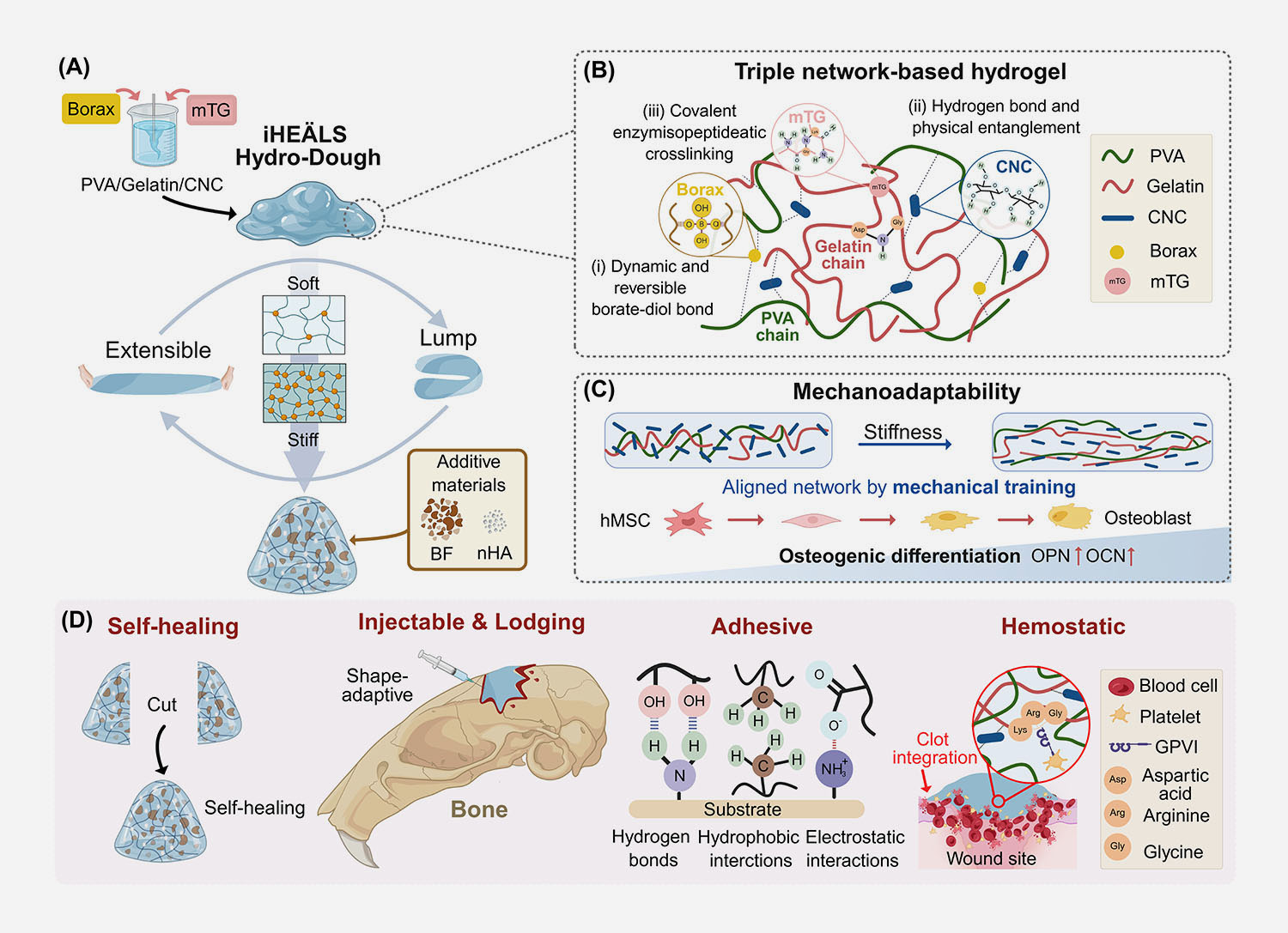
The study demonstrates the potential of the novel biomaterial, named iHEÄLS, as a versatile platform for complex craniomaxillofacial reconstruction.